


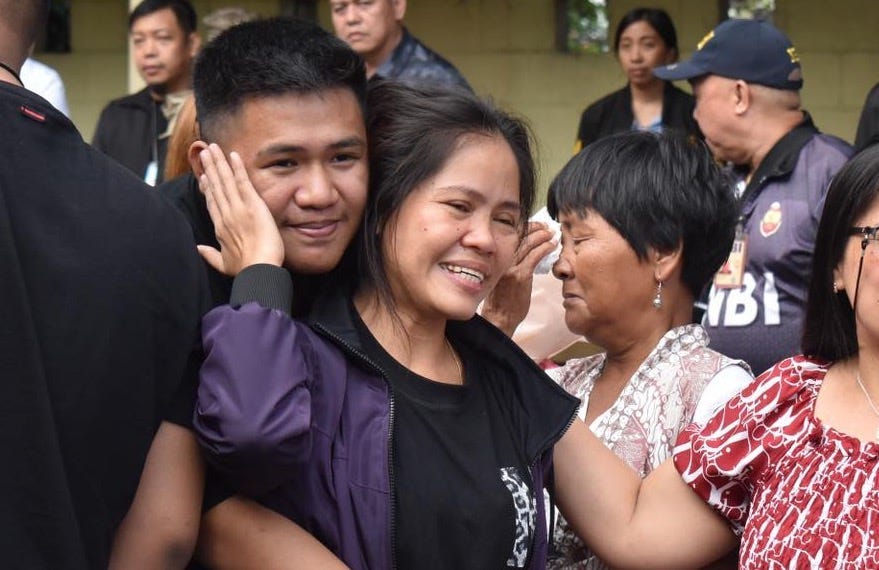
16 years ago, Filipino overseas worker Mary Jane Veloso arrived in Indonesia after being told a job was waiting for her there.
When she arrived at Yogyakarta airport on April 25 2010, 2.6 kilograms of heroin were discovered in a suitcase she was carrying. Though she maintained that she had no knowledge of the drugs and that the suitcase had been given to her by others, she was ultimately convicted of drug trafficking and sentenced to death.
11 years ago, in April 2015, Mary Jane was moved to Nusa Kambangan, the island where Indonesia carries out executions, where she was due to be executed by firing squad. Barely an hour before her scheduled execution, following campaigns against her sentence and developments in the Philippines relating to her case, she was granted a last-minute reprieve.
18 months ago, on December 18 2024, after sustained legal and diplomatic efforts in Indonesia and the Philippines, Mary Jane was repatriated to her home country. Upon her arrival she was taken to a women’s correctional facility, where she is currently being detained.
Earlier this week, her lawyers announced that she would be allowed to testify in court against her alleged recruiters for the first time since returning home. While her legal team has welcomed this development as an opportunity for Mary Jane to tell her story on the record, they are also continuing their efforts to secure full, unconditional clemency and her release from prison.
Trafficking, or Trafficked?
In November 2025, I published an interview with Mary Jane’s lawyer, Edre Olalia, discussing his work on Mary Jane’s case in both Indonesia and the Philippines. Then, in March this year, I was commissioned to produce a podcast on Mary Jane’s case by the Anti-Death Penalty Asia Network (ADPAN) alongside the Coalition Against the Death Penalty (CADP) in the Philippines.
There was limited time and a limited budget (plus several thousand miles between my current location and Southeast Asia), but I was lucky enough to arrange a conversation between Edre and Yuni Asriyanti, the commissioner at Indonesian rights group the National Commission on Violence against Women, commonly known as Komnas Perempuan.
The discussion between Yuni and Edre, chaired by ADPAN’s Regional Director Tom Temprosa, provides remarkable first-hand accounts of the legal and advocacy work in two countries to save Mary Jane.
The finished episode is Trafficking, or Trafficked? The Story of Mary Jane Veloso. More story-driven and documentary-style than the usual interviews I publish on Currents (and more time-consuming, hence the shortage of other recent material), it was a hugely rewarding piece to work on.
In it, you’ll hear what it was like for the people on the ground working on Mary Jane’s case: the lead-up to her scheduled execution and how close she came to being killed; the reaction to her return to the Philippines; her current legal status and the ongoing work to have her released; and the wider issues Mary Jane’s case highlights, from changes in Indonesia’s death penalty regime, to the exploitation and mistreatment that countless overseas workers continue to face.
For additional information on Mary Jane’s case, I’d also recommend listening to Edre’s interview from last year, where he also discusses his work on the case of Flor Contemplacion, a Filipino overseas worker who who became a household name in the Philippines after she was executed in Singapore in 1995.
Mary Jane’s continued incarceration presents her lawyers with further challenges to overcome, but her story demonstrates how, when it comes to the capital punishment, matters of life or death can hinge on the intersections of poverty and gender, diplomacy, and politics. The last-minute reprieve she received over a decade ago shows how, as long as someone is still alive, there can always be hope.